
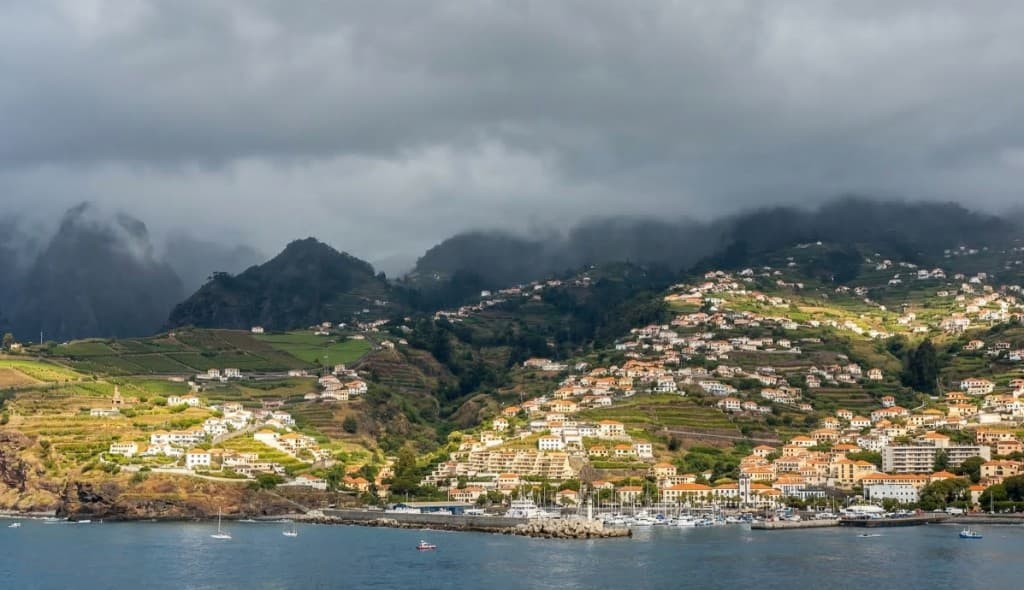
Madeira is world-renowned as the island of eternal spring, but its dramatic topography tells a more complex story. The island rises abruptly from sea level to 1,800 meters in under 45 minutes, and this vertical range means weather conditions can change drastically over very short distances. Many property buyers assume every house enjoys the same sunny weather, but the reality of island geography means that altitude, cloud cover, and sun exposure play a critical role in your home's health.
The Altitude Cooling Effect
While the southern coastal areas like Funchal or Calheta act as natural sun traps with warm temperatures, moving just a few hundred meters up the hillside changes the climate entirely. The urban perimeter of Funchal alone extends from sea level up to approximately 800 meters in altitude, making it very common to experience two completely different climates within the same city.
As a general meteorological rule on the island, the temperature decreases by about 0.6°C to 0.7°C for every 100 meters you ascend. This means a property situated at 500 or 600 meters above sea level—such as in the parish of Monte—will be noticeably colder than one on the coast.
Living Inside the Clouds
Madeira's towering central mountains create a massive physical barrier against the Atlantic trade winds. When moist air hits these slopes, it is forced upward, cooling rapidly and condensing into thick orographic clouds. Because of this, higher elevation areas frequently experience significantly more cloudiness, rain, and wind than the clear coastal zones.
In fact, at higher altitudes (specifically between 800 and 1,600 meters), the island experiences a phenomenon known as "cloud milking" or occult precipitation. Here, the vegetation and surfaces physically capture water directly from the constant fog and mist. Even if your home is situated lower than this, being in the mid-altitudes means your property may spend a significant portion of the day shrouded in a cold, damp cloud layer, blocking out the drying power of the sun.
The Valley Humidity Traps
Elevation isn't the only factor; the island's deep volcanic valleys, such as Curral das Freiras or São Vicente, follow their own thermal clocks. In these locations, steep mountain walls create a "shadow curtain," meaning direct sunlight might not reach the valley floor until late in the morning. Without early morning sun to burn off the dew, these valleys act as humidity basins, keeping the air crisp, damp, and much colder than the thermometer suggests.
Protecting Your High-Altitude Property
If you own a home in a higher-elevation area or tucked inside a deep valley, the lack of direct sun and constant exposure to low clouds creates a perfect storm for dampness. When these properties are left unoccupied, the trapped humidity can quickly lead to severe mold and structural damage.
Don't let the mountain mist damage your home. Contact us to set up a customized care plan.